
Inventory management is a critical aspect of any successful business. Effectively tracking and managing your products is essential for meeting customer demand, minimizing waste, and maximizing profitability. A key component of effective inventory management is the proper utilization of Stock Keeping Units (SKUs). Decoding SKUs and understanding their significance can dramatically improve your business operations, from warehouse organization to sales forecasting.
This article will delve into the importance of SKUs for effective inventory management. We will explore what SKUs are, how they are structured, and why they are indispensable for optimizing your inventory processes. Learn how decoding SKUs allows for greater accuracy in tracking inventory levels, streamlining fulfillment processes, and making data-driven decisions. By understanding the vital role SKUs play, you can unlock the full potential of your inventory management system and drive significant improvements in your business.
What is a Stock Keeping Unit (SKU)?
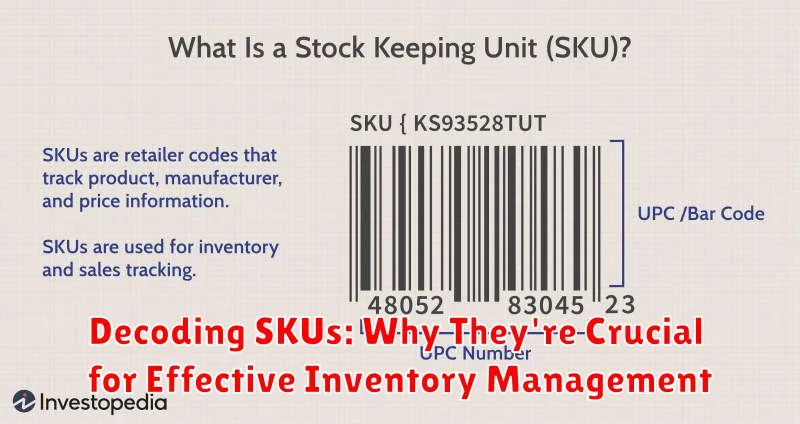
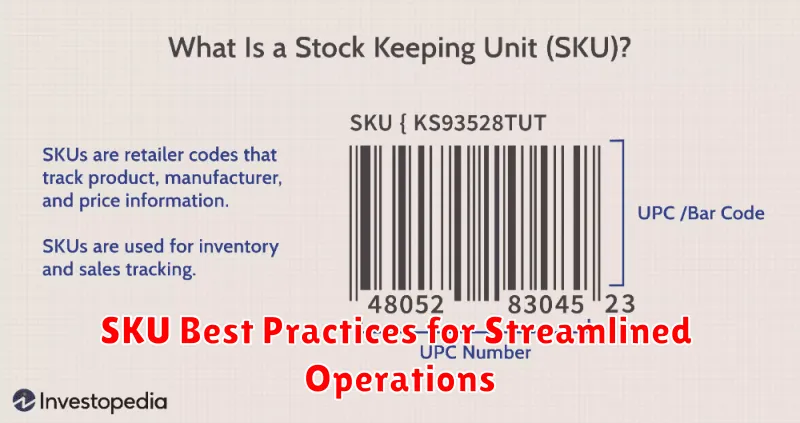
A Stock Keeping Unit (SKU) is a unique alphanumeric code used to identify and track individual products within a company’s inventory. Think of it as a product’s internal ID card. It’s a scannable barcode that allows businesses to quickly and accurately manage, track, and differentiate each distinct item they sell.
SKUs aren’t universal; they are business-specific. One company’s SKU for a particular product will be different from another’s, even if the product itself is identical. This allows each business to manage its own inventory in the way that best suits its needs.
While a product’s barcode may be the same across different retailers (like a UPC or EAN), the SKU provides internal clarity. It differentiates, for instance, a blue, medium t-shirt from a red, large t-shirt, even if they share the same base product UPC. This granular level of identification is what makes SKUs so powerful for inventory control.
How SKUs Work in Inventory Management
SKUs act as a unique identifier for each product variation within your inventory. This granular identification is key for accurate tracking and management. When a product is received, its corresponding SKU is recorded in the system, updating the inventory count. As sales occur, the SKU is used to deduct the sold item, ensuring real-time inventory updates.
This real-time tracking facilitates efficient stock replenishment. By monitoring SKU performance, businesses can anticipate demand and prevent stockouts. Low stock levels for a particular SKU trigger reordering processes, maintaining optimal inventory levels. Conversely, poor-performing SKUs can be identified quickly, allowing for informed decisions regarding pricing, promotions, or discontinuation.
Beyond stock control, SKUs play a crucial role in warehouse organization. By assigning specific locations to each SKU, businesses can optimize warehouse layout and streamline the picking and packing process. This improves order fulfillment speed and reduces errors, leading to increased customer satisfaction.
Benefits of Using SKUs
Implementing a robust SKU system offers numerous advantages for businesses of all sizes. Improved inventory accuracy is a key benefit, as SKUs allow for precise tracking of stock levels. This minimizes the risk of stockouts and overstocking, leading to increased profitability.
SKUs enable efficient inventory management by streamlining processes such as receiving, picking, and shipping. This enhanced efficiency translates to reduced labor costs and faster order fulfillment times. Simplified stocktaking is another advantage, as SKUs facilitate quick and accurate inventory counts.
Data-driven decision making becomes possible with the detailed insights provided by SKU data. By analyzing sales trends and product performance based on SKUs, businesses can optimize pricing strategies and inventory levels. Furthermore, SKUs are essential for effective warehouse organization, allowing for logical product placement and faster retrieval.
Creating Effective SKUs
Creating effective SKUs involves a thoughtful process to ensure they are unique, descriptive, and supportive of efficient operations. A well-structured SKU architecture provides the foundation for accurate tracking and optimized inventory management.
Start by defining a consistent structure. Uniqueness is paramount. Each SKU must represent one specific product variation. Consider using a combination of letters and numbers to represent different product attributes like color, size, or style.
Clarity is also key. While brevity is desirable, avoid excessive abbreviation that could lead to confusion. The SKU should be easily decipherable by anyone handling the product. For example, a T-shirt in blue, size medium could have a SKU like “TSHIRT-BLUE-M”.
Avoid using special characters or spaces as these can cause issues with certain systems. Keep the SKU length reasonable to facilitate efficient data entry and scanning.
SKU Best Practices for Streamlined Operations
Implementing SKUs effectively requires adherence to best practices. This ensures data accuracy, operational efficiency, and scalability.
Uniqueness: Each SKU must be unique. Duplicate SKUs create confusion and reporting errors.
Consistency: Maintain a consistent format across all SKUs. This simplifies data analysis and integration with other systems.
Brevity: Keep SKUs as short as possible while remaining descriptive. Shorter SKUs are easier to manage and reduce data entry errors.
Logic: Incorporate a logical structure that reflects product attributes, such as category, size, or color. This aids in quick identification and sorting.
Avoid Special Characters: Refrain from using spaces, symbols, or special characters in your SKUs as these can cause compatibility issues with some systems.
Regular Reviews: Periodically review your SKU system for redundancies, outdated codes, or areas for improvement.
Common SKU Mistakes to Avoid
Creating effective SKUs is crucial for streamlined inventory management. Avoiding these common mistakes can save you time and prevent costly errors.
Using Meaningful Characters
Avoid using special characters like hyphens, slashes, or spaces in your SKUs. These can cause issues with certain systems and databases. Stick to alphanumeric characters.
Starting with Zero
While seemingly harmless, starting an SKU with a zero can lead to problems in spreadsheets and other software where leading zeros might be truncated. Begin your SKUs with a letter or a non-zero number.
Overly Complex SKUs
Keep SKUs concise and easy to scan. Overly long or complex SKUs increase the risk of manual entry errors and slow down warehouse processes. Aim for a balance between brevity and sufficient information.
Inconsistent Formatting
Maintain a consistent SKU structure across all your products. This ensures uniformity and makes it easier to analyze data and generate reports.
Not Reviewing Regularly
Your inventory evolves, and so should your SKUs. Regularly review your SKU system to ensure it remains efficient and accurately reflects your current product offerings.
Integrating SKUs with Your E-commerce Platform
Seamless integration between your SKUs and e-commerce platform is essential for streamlined operations. A well-integrated system automatically updates inventory levels, preventing overselling and stockouts. This automation saves valuable time and resources, allowing you to focus on other aspects of your business.
Most e-commerce platforms allow for direct SKU input during product listing creation. Ensure your SKUs are accurately entered into the designated fields. Some platforms offer bulk upload capabilities, enabling efficient management of large product catalogs. Utilize these features to streamline the integration process.
Integrating SKUs with your platform also facilitates accurate order fulfillment. Warehouse staff can quickly locate and pick items based on their SKUs, minimizing errors and speeding up shipping times. This efficiency leads to improved customer satisfaction and a more professional brand image.
Leveraging SKUs for Data-Driven Decisions
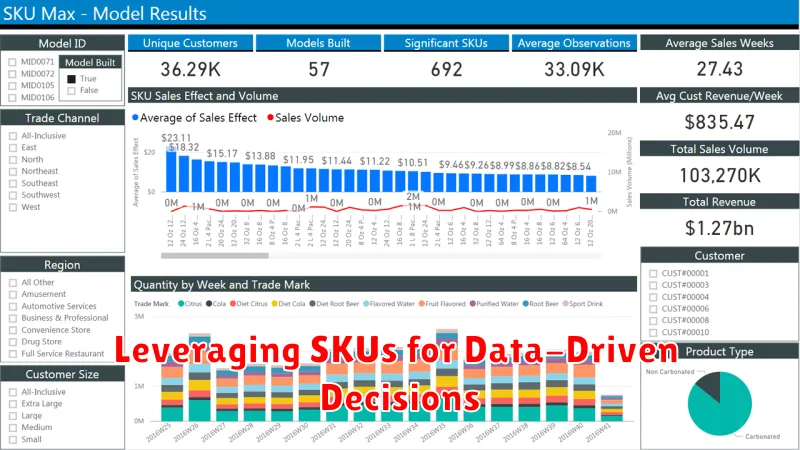
Well-structured SKUs unlock powerful data analysis capabilities, enabling data-driven decisions that optimize inventory management. By analyzing sales data tied to specific SKUs, businesses can identify top-performing products and slow-moving items.
This information is crucial for forecasting demand and adjusting purchasing strategies. Overstocking can be minimized by reducing orders for underperforming products, freeing up valuable warehouse space and capital. Conversely, identifying trending products allows for proactive ordering to meet increased customer demand and prevent stockouts.
Furthermore, SKU data can be used to analyze sales trends by different product attributes, such as color, size, or material. This granular level of insight helps businesses refine their product offerings and cater to customer preferences more effectively. By understanding which variations are most popular, companies can make informed decisions about product development and marketing strategies.
