
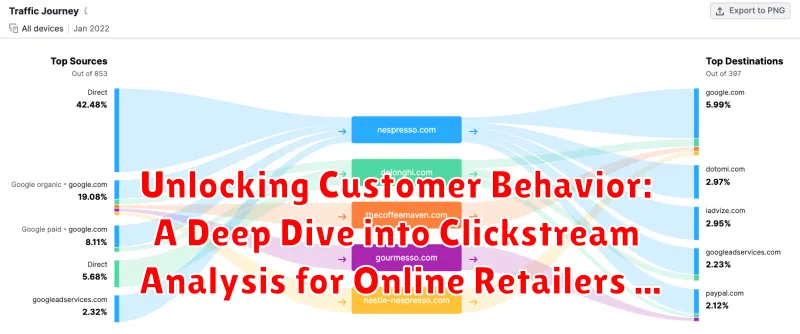
In today’s fiercely competitive online retail landscape, understanding customer behavior is no longer a luxury, but a necessity. Clickstream analysis offers a powerful lens through which online retailers can dissect the digital footprints of their customers, revealing invaluable insights into their browsing patterns, preferences, and purchase decisions. This deep dive into clickstream analysis will explore how leveraging this data can empower online retailers to optimize their website design, personalize marketing campaigns, and ultimately, boost sales and customer satisfaction. By unlocking the secrets hidden within clickstream data, businesses can gain a crucial competitive edge and drive sustainable growth.
This article will provide a comprehensive guide to clickstream analysis for online retailers, covering key aspects from data collection and interpretation to practical application and best practices. We will delve into the various customer behaviors that can be elucidated through clickstream data, including product discovery patterns, cart abandonment rates, and conversion funnels. By the end of this article, you will possess a robust understanding of how to harness the power of clickstream analysis to enhance your online retail strategy and unlock the full potential of your customer data.
Understanding the Power of Clickstream Data
Clickstream data provides a wealth of information about how customers interact with an online retail environment. It offers a granular view of their browsing behavior, revealing valuable insights into their preferences, intentions, and decision-making process. This data is essential for understanding what motivates customers, what challenges they face, and ultimately, what drives conversions.
By capturing and analyzing clickstream data, online retailers gain a competitive edge. This data allows businesses to move beyond simple metrics like page views and bounce rates, delving into the nuances of individual customer journeys. Understanding these journeys is key to optimizing the user experience and driving business growth.
Key data points collected as part of clickstream analysis include pages visited, products viewed, search queries entered, time spent on each page, and the order in which actions are performed. This data, when analyzed effectively, paints a comprehensive picture of customer behavior, allowing retailers to personalize the shopping experience and optimize their online presence.
How Clickstream Analysis Works
Clickstream analysis involves collecting, analyzing, and reporting aggregate data about which pages a website visitor visits, and in what order. This data is gathered through various methods.
Data Collection Methods
Commonly used methods include server logs, which record website activity on the server-side; page tagging, which uses JavaScript code snippets to track user interactions on the client-side; and cookies, small text files stored on a user’s computer that track browsing history.
These methods capture various data points like the pages viewed, time spent on each page, the order of page visits, the referring website, and the user’s IP address. This raw data is then processed and analyzed to understand user behavior patterns.
Data Analysis Techniques
Various techniques are employed to analyze clickstream data, including path analysis to understand common navigation paths, segmentation to group users with similar behavior, and trend analysis to identify emerging patterns over time.
Benefits of Clickstream Analysis for Online Retail
Clickstream analysis offers a wealth of advantages for online retailers seeking to optimize their websites and marketing strategies. By understanding customer browsing behavior, businesses can make data-driven decisions that lead to increased sales and customer satisfaction. Improved website design is a key benefit, as clickstream data reveals how users navigate pages, identifying pain points and areas for improvement. This can involve optimizing product placement, streamlining checkout processes, and improving site navigation for a seamless user experience.
Personalized product recommendations are another significant advantage. By analyzing browsing history and purchase patterns, retailers can tailor product suggestions to individual customer preferences. This targeted approach increases the likelihood of conversion and boosts sales. Furthermore, clickstream analysis allows for optimized marketing campaigns. By understanding which marketing channels drive traffic and conversions, retailers can allocate their budget more effectively. This data-driven approach maximizes ROI and ensures that marketing efforts are reaching the right audience.
Enhanced customer segmentation is another valuable benefit. Clickstream analysis allows businesses to group customers based on shared browsing behaviors and preferences. This granular understanding enables targeted marketing and personalized promotions, further driving conversions. Finally, improved customer service is achievable by analyzing customer journeys and identifying common issues or roadblocks encountered on the website. Addressing these issues proactively enhances customer satisfaction and fosters loyalty.
Implementing Clickstream Analysis: Tools and Techniques
Implementing clickstream analysis requires a combination of the right tools and effective techniques. Selecting appropriate tools depends heavily on the specific needs and resources of the business.
Tools for Clickstream Analysis
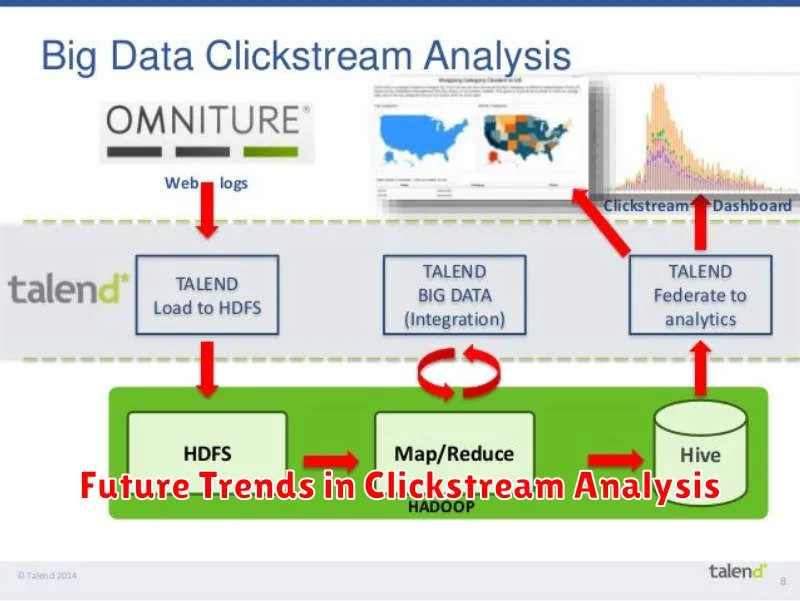
Several categories of tools support clickstream analysis. Web analytics platforms like Google Analytics provide basic clickstream data, offering insights into user behavior. For more advanced analysis, dedicated clickstream analysis software offers features like session replay, heatmaps, and cohort analysis. Big data platforms, such as Hadoop and Spark, are necessary for handling massive datasets and conducting complex analyses. Finally, data visualization tools help translate raw data into understandable reports and dashboards.
Techniques for Effective Analysis
Applying the right techniques is crucial for extracting meaningful insights. Segmentation allows grouping users based on shared characteristics. Cohort analysis tracks user behavior over time. Path analysis visualizes the most common navigation routes within a website. Machine learning algorithms can be applied to predict future behavior and personalize customer experiences. Proper implementation of these techniques requires careful planning and a clear understanding of business objectives.
Real-World Examples of Clickstream Analysis in Action
Let’s explore how clickstream analysis translates into tangible benefits for online retailers through real-world scenarios.
Case Study 1: Personalized Product Recommendations
An online clothing retailer uses clickstream data to analyze browsing patterns and purchase history. Customers frequently viewing jeans and sweaters receive personalized recommendations for complementary items like belts and scarves, resulting in increased average order value.
Case Study 2: Optimizing Website Navigation
A large electronics retailer analyzes clickstream data to understand how customers navigate their website. They discover a high drop-off rate on a specific product category page. By simplifying the navigation and improving the page layout based on clickstream insights, they reduce bounce rates and improve conversions.
Case Study 3: Targeted Marketing Campaigns
An online bookstore segments customers based on their clickstream activity, identifying those interested in specific genres. They then deliver targeted email campaigns promoting relevant new releases and special offers, leading to higher click-through rates and increased sales.
Common Challenges in Clickstream Analysis (and How to Overcome Them)
Clickstream analysis, while powerful, presents certain challenges. Data volume is a primary concern. The sheer amount of data generated can be overwhelming, requiring robust infrastructure and efficient processing techniques. Investing in scalable cloud solutions and implementing data aggregation strategies can mitigate this.
Data quality is another hurdle. Incomplete sessions, bot activity, and inaccurate timestamps can skew results. Implementing data validation rules and filtering mechanisms is crucial for ensuring reliable insights. Addressing these issues head-on improves the accuracy of analysis.
Data privacy is paramount. Anonymizing data and complying with regulations like GDPR is essential. Employing robust data security measures and adopting privacy-preserving analytics techniques are critical for maintaining ethical practices.
Finally, interpreting the data can be complex. Identifying meaningful patterns and translating them into actionable strategies requires expertise. Collaborating with experienced analysts or investing in data visualization tools can facilitate better understanding and decision-making.
Future Trends in Clickstream Analysis
The future of clickstream analysis promises even more sophisticated insights into customer behavior. Artificial intelligence (AI) and machine learning (ML) will play a crucial role, enabling predictive analysis of customer journeys. This will allow retailers to anticipate customer needs and personalize experiences in real-time.
Real-time analysis will become increasingly important. Rather than relying on historical data, retailers will be able to analyze clickstream data as it’s generated, allowing for immediate reactions to customer behavior. This could involve personalized recommendations, targeted promotions, or even dynamic pricing adjustments.
The integration of clickstream data with other data sources, such as customer relationship management (CRM) systems and social media data, will provide a more holistic view of the customer. This will enable retailers to create highly personalized and targeted marketing campaigns.
Finally, there’s a growing trend towards using clickstream analysis to optimize the entire customer experience, not just online interactions. By understanding online behavior, retailers can gain insights that can be applied to offline channels, creating a seamless and integrated experience.
Key Metrics to Track with Clickstream Analysis
Clickstream analysis provides valuable data for understanding customer behavior. Tracking key metrics allows businesses to optimize their online stores and improve the customer journey. Here are some crucial metrics to consider:
Website Traffic Metrics
Click-through rate (CTR) measures the percentage of users who click on a specific link or element. Bounce rate reveals the percentage of visitors who leave a website after viewing only one page. Analyzing these metrics helps identify areas for improvement in website design and content.
Customer Navigation Metrics
Pages per visit indicates the average number of pages viewed during a session. Average session duration measures the time spent on the website per visit. These metrics provide insights into user engagement and content effectiveness.
Conversion Metrics
Conversion rate is the percentage of visitors who complete a desired action, such as making a purchase. Cart abandonment rate tracks the percentage of users who add items to their cart but do not complete the purchase. Analyzing these metrics helps identify bottlenecks in the checkout process and optimize conversion funnels.
